Institutional Real Estate & Real Asset Financial ModelsPortfolio analytics, financial models, and investment performance analysis
Services
Model Audits & Rebuilds
Independent review and restructuring of complex or legacy financial models to improve transparency, speed, and auditability.Portfolio Analytics
Portfolio-level performance tools for valuation, attribution analysis, liquidity forecasting, and investor reporting.Waterfall & Promote Modeling
Design and validation of complex partnership waterfalls, including cross-asset promotes and fund-level structures.
Valuation & Scenario Analysis
Independent review of valuation assumptions, development of downside scenarios and portfolio sensitivities.Financial Model Development
Development of institutional-grade Excel models for portfolios, acquisitions, and developments.Excel Training
Custom Excel trainings for your organization across a variety of topics including modern Excel and dynamic arrays.
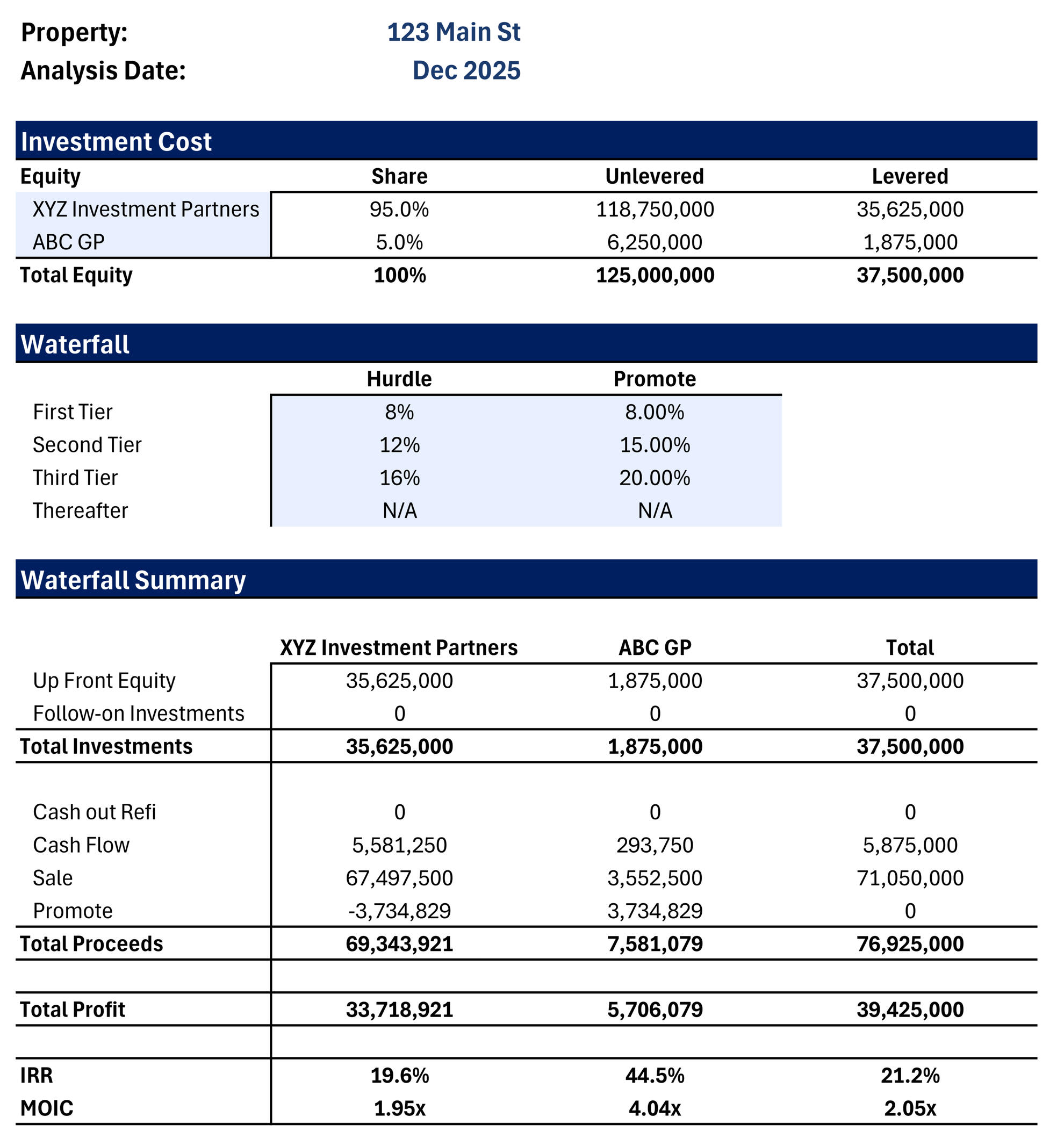
Investment and returns summary
If you would like to engage on any of the above services or have questions about custom solutions please reach out through the contact button below
Case Studies
Portfolio Valuation Model
An institutional real estate investment team required a streamlined model to support quarterly valuation committee meetings. The existing process relied on fragmented data sources and manual updates across multiple analyst teams.The objective was to build a portfolio-level model integrating Argus underwriting data, accounting records, and third-party valuation inputs into a single transparent analytical tool. The resulting model consolidated data across more than $1.5B and 50 assets, enabling executives to analyze valuation changes, capital expenditures, and sensitivities in real time during investment committee discussions.
Waterfall Audits
Institutional portfolios often include complex partnership structures with multiple promote tiers, preferred equity layers, and cross-asset waterfalls. With one client, asset managers were calculating returns independently, leading to inconsistent interpretation of fund agreements and reporting discrepancies.On behalf of a leading Sovereign Wealth Fund, we developed standardized waterfall models for individual assets and crossed European waterfalls, ensuring alignment with partnership agreements and consistent return calculations across their $6B real estate investment. These models improved transparency for investment teams and provided a reliable framework for forecasting distributions, investor returns, and promote participation.
Scenario & Downside Analysis
Investment committees often require the evaluation of market scenarios including changes in cap rates and discount rates, or increased capital requirements.We were engaged by a team whose workflow required manually updating Argus files during executive risk meetings, slowing decision-making and introducing version-control errors. We developed a sensitivity tool that worked with Argus to allow the testing of valuation and return assumptions in real time while maintaining consistency with underlying models. These tools provided immediate visibility into scenarios and helped teams evaluate risk across the portfolio.
Model Audits & Rebuilds
Evolving models over years of analyst usage often resulting in complex spreadsheets with inconsistent formulas, hard-coded inputs, and hidden VBA logic. We have performed numerous model audits and rebuillds to improve clarity, performance, and auditability.By centralizing inputs, standardizing formulas, and removing unnecessary complexity, these rebuilt models became significantly faster and easier for analyst teams to maintain. The result is a transparent modeling framework that supports both ongoing portfolio management and ad-hoc investment analysis. The largest implementation of this resulted in over 100 asset models for a $15B portfolio.
Portfolio Analytics & Reporting
Institutional investment teams frequently rely on multiple systems including accounting platforms, asset-level models, and proprietary software (such as Argus) making it difficult to generate consistent portfolio insights. Out team has built centralized analytics tools that consolidate data from these sources into a single reporting structure designed for investment committees and senior leadership.These tools can track portfolio performance metrics including NAV, IRR, cash flow projections, and operating performance across hundreds of assets. By standardizing inputs and automating roll-ups, the models significantly reduce reporting timelines while improving transparency and consistency across teams.
Project Underwriting
Our team has supported underwriting for projects through $1B+ portfolio acquisitions. These models evaluated projected operating performance, expected capital expenditures, potential financing structures, and investor return profiles across multiple investment scenarios.The underwriting process involved integrating Argus cash flows, capital planning, debt assumptions, and partnership waterfalls to evaluate investment risk and return outcomes. These models supported investment committee decisions and performance targets.
Dynamic Portfolio Dashboards
Custom built portfolio level dashboards perfect for executives and portfolio overviews. All reports have interactive analysis and can be navigated via desktop or mobile.
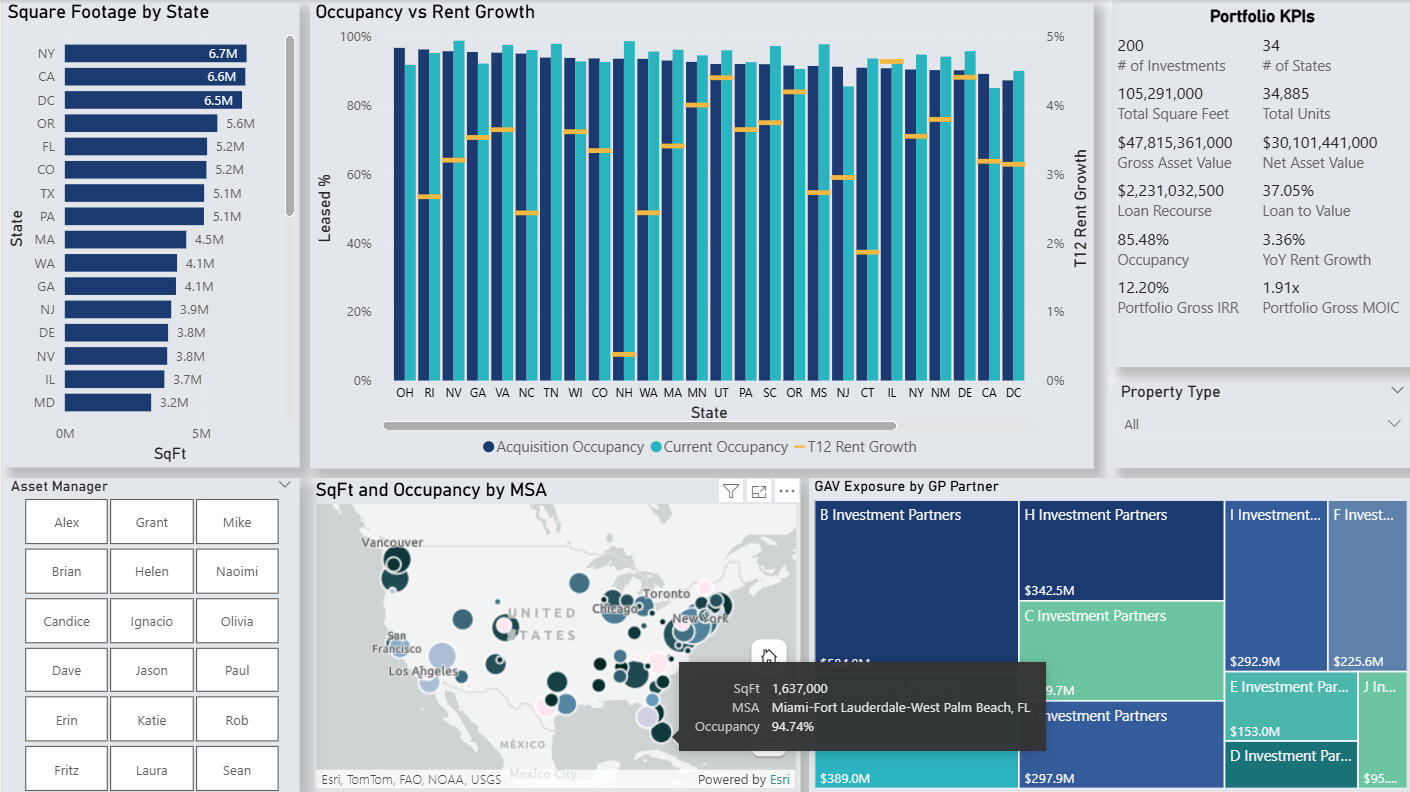
Executive portfolio summary with KPIs
Contact Us
For project inquiries or consulting engagements please complete the form below or reach out at:
[email protected]
About me
Ben deLeon is the founder of deLeon Advisory, an independent consulting practice specializing in financial modeling, portfolio analytics, and reporting solutions for real asset investment teams.Ben has supported real estate investment teams managing multi-billion-dollar portfolios across acquisitions, asset management, and portfolio reporting across real estate and real asset portfolios. His work includes complex valuation models, partnership waterfall analyses, and portfolio analytics platforms that integrate underwriting, accounting, and valuation data into unified decision-support tools.Ben also competes in international Excel modeling competitions and is among the top Excel modelers in the world. He is regularly among the top 10 US competitors in the Financial Modeling World Cup, and has ranked 10th in the Microsoft Excel World Championships.